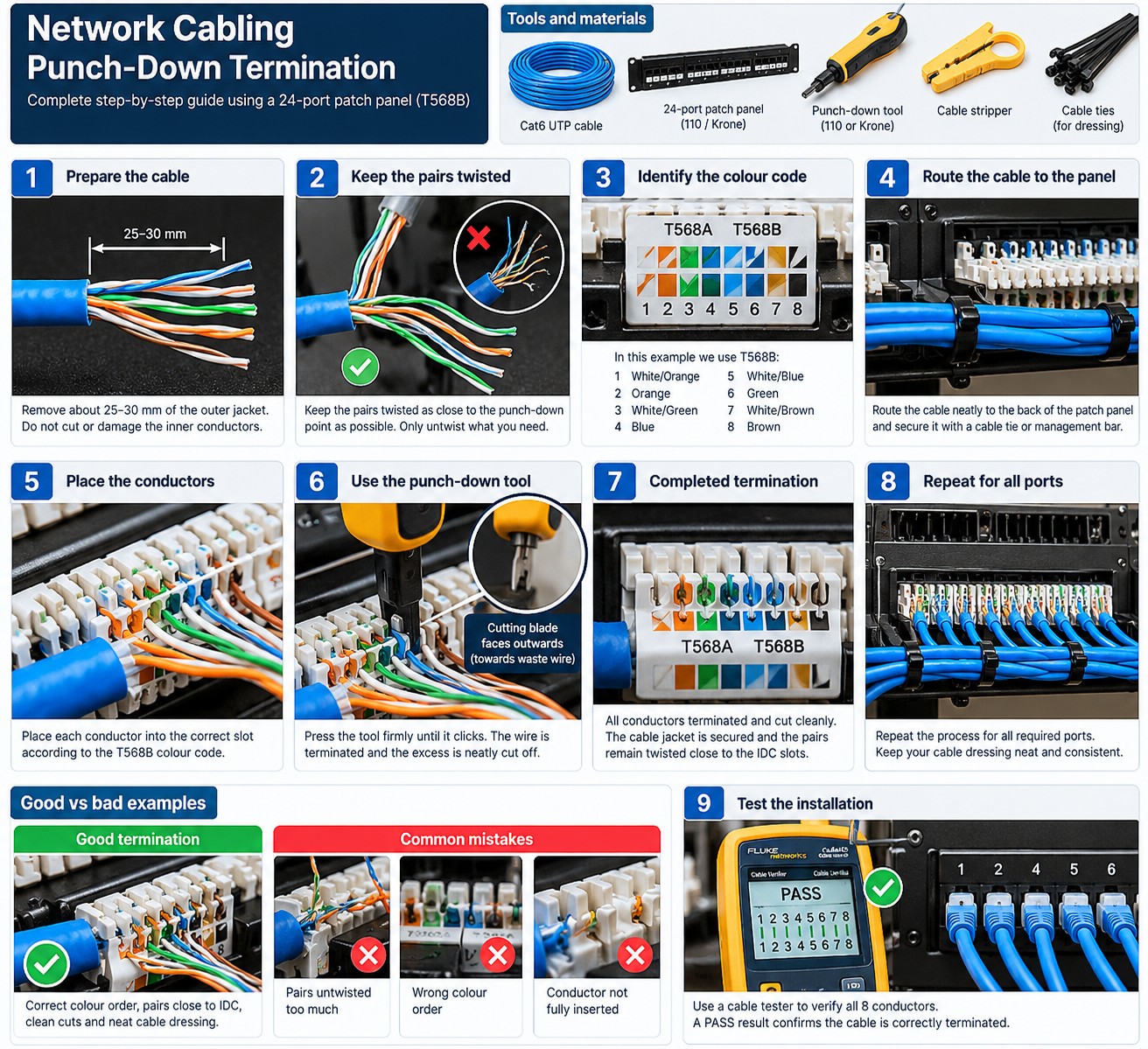
1. Understand the design before touching the hardware
Use certification results as diagnostic evidence by understanding what wiremap, NEXT, return loss, insertion loss, ACR-F and resistance measurements are telling you.
The practical rule is to separate what is physically possible from what is supported, what is supported from what is well designed, and what is well designed from what has actually been tested. Product names and connector shapes are useful clues, but they are not substitutes for the exact platform documentation.
Server Warehouse category links on this page identify relevant hardware families. Compatibility with a specific server, switch, storage platform, UPS, camera or cabling system must still be verified against the exact model and application.
2. Technical principles that matter
Wiremap is only the first gate
A link can have correct pin continuity and still fail high-frequency performance.
NEXT often points attention toward pair geometry and termination
Excessive untwist, poor connector geometry or disturbed pairs near a termination can reduce crosstalk margin.
Return loss is about impedance consistency
Kinks, poor terminations, incompatible components or geometry changes can create reflections.
Insertion loss grows with length and loss characteristics
Excessive length, damaged cable or unsuitable components can consume margin.
Distance-to-fault tools narrow the inspection area
A tester that localises an event can prevent technicians from reterminating both ends blindly.
3. Field workflow
Use a repeatable process so that the result can be explained and handed over to another technician. Record the starting state before changing anything.
- Save the original failing test result before touching the link.
- Identify the worst parameter, pair and frequency/distance information.
- Inspect the end or cable section indicated by the evidence.
- Correct one suspected cause at a time.
- Retest with the same limit and adapters.
- Keep both failure and final pass result when documenting corrective work.
Where the manufacturer supplies a model-specific installation, population, compatibility or service procedure, that procedure takes priority over a generic field rule. The purpose of this workflow is to make sure the correct documentation is used at the correct point.
4. Worked field scenario
A Cat6A permanent link passes wiremap but fails NEXT near the patch-panel end. Instead of replacing the horizontal cable, the technician inspects pair untwist and dressing at the panel, corrects the termination and retests. The fault signature directed the work.
The important lesson is not the brand in the example. It is the reasoning chain: identify the requirement, trace the complete path, find the limiting or unsupported element, correct that element, and then prove the result with measurements or platform health evidence.
5. Fault-finding decision table
| What you see | Where to investigate next |
|---|---|
| NEXT failure close to one end | Inspect termination geometry, pair untwist and connector compatibility at that end. |
| Return loss failure at a distinct distance | Inspect for a kink, coupler, poor connection or impedance change near the indicated point. |
| Insertion loss failure across long link | Verify actual length, cable type, damage and test setup. |
| Marginal results across many links | Check common workmanship, component batch, test limit and tester adapter condition. |
Change one variable at a time where practical. A fault that disappears after five simultaneous changes teaches very little and can return later because the real cause was never isolated.
6. What correct should look like
- Correct test limit is selected
- Permanent link/channel/MPTL adapters match the test type
- Final result passes without unresolved warnings
- Failure evidence is retained for reworked links
- Link ID matches drawings and labels
- Tester calibration/verification status is documented
Acceptance is evidence, not confidence. Save configuration, test results, screenshots, logs, photographs, serial numbers or drawings appropriate to the job so that the next person can establish the known-good state.