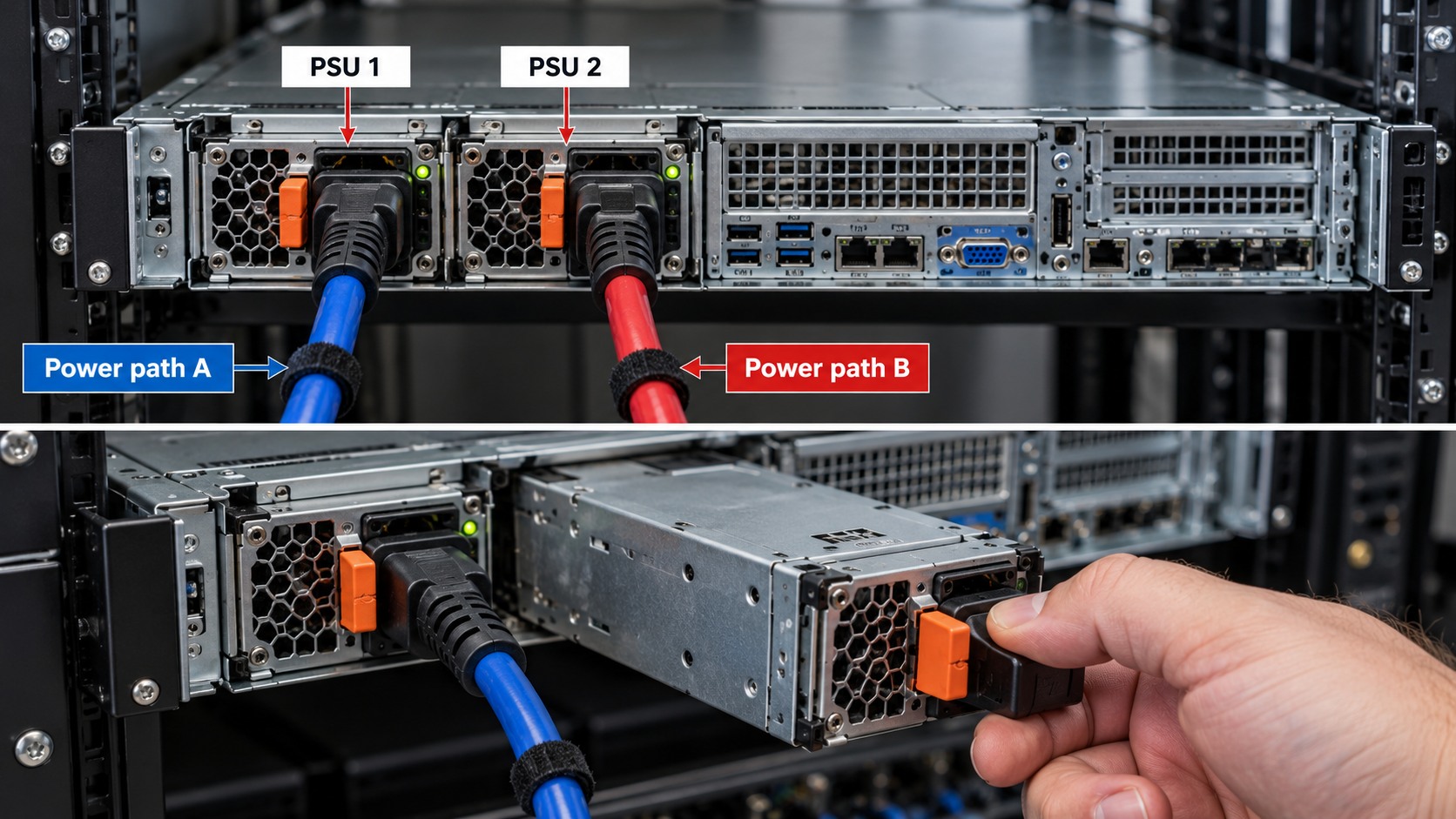
1. Understand the design before touching the hardware
Plan how a UPS behaves during generator start, transfer and frequency/voltage variation without assuming every generator and UPS combination will operate cleanly together.
The practical rule is to separate what is physically possible from what is supported, what is supported from what is well designed, and what is well designed from what has actually been tested. Product names and connector shapes are useful clues, but they are not substitutes for the exact platform documentation.
Server Warehouse category links on this page identify relevant hardware families. Compatibility with a specific server, switch, storage platform, UPS, camera or cabling system must still be verified against the exact model and application.
2. Technical principles that matter
The UPS bridges the transfer event
During utility failure the UPS must support the load until the generator and transfer system provide acceptable input.
Input tolerance matters
UPS topology and configuration determine what voltage/frequency variation is accepted before the UPS returns to battery.
Generator sizing is not only UPS load watts
Starting loads, power factor, harmonics, charger demand and other building loads can influence generator behaviour.
Repeated battery transfers are a warning
If the UPS oscillates between generator and battery, investigate input quality and configuration rather than accepting the cycling.
This is a coordinated power-system design
Generator, ATS, UPS, distribution and critical loads should be reviewed together by qualified electrical professionals.
3. Field workflow
Use a repeatable process so that the result can be explained and handed over to another technician. Record the starting state before changing anything.
- Document UPS model, topology and input requirements.
- Document generator/ATS ratings and critical/noncritical loads.
- Review UPS input frequency/voltage settings supported for generator operation.
- Plan generator start and transfer test with appropriate site professionals.
- Monitor UPS events during transfer and steady generator operation.
- Record any battery cycling, bypass events or alarms and correct the system before acceptance.
Where the manufacturer supplies a model-specific installation, population, compatibility or service procedure, that procedure takes priority over a generic field rule. The purpose of this workflow is to make sure the correct documentation is used at the correct point.
4. Worked field scenario
A generator starts successfully but the UPS repeatedly rejects its input and returns to battery. The generator is running, yet the critical load is still consuming battery runtime. Event logs and electrical measurements are needed to determine whether frequency, voltage or another compatibility issue is outside the UPS acceptance window.
The important lesson is not the brand in the example. It is the reasoning chain: identify the requirement, trace the complete path, find the limiting or unsupported element, correct that element, and then prove the result with measurements or platform health evidence.
5. Fault-finding decision table
| What you see | Where to investigate next |
|---|---|
| UPS stays on battery after generator stabilises | Check input voltage/frequency against UPS acceptance and supported configuration. |
| UPS transfers repeatedly | Investigate generator regulation, load steps and UPS sensitivity settings using manufacturer/site guidance. |
| Generator overloads when utility fails | Review total connected load and UPS charger/load behaviour as part of system sizing. |
| UPS enters bypass unexpectedly | Treat it as a protection-state change and investigate event logs before declaring the test successful. |
Change one variable at a time where practical. A fault that disappears after five simultaneous changes teaches very little and can return later because the real cause was never isolated.
6. What correct should look like
- Generator start/transfer test is documented
- UPS returns to normal protected operation
- No repeated battery cycling
- No unexpected bypass event
- Critical load remains stable
- Electrical contractor/site records and UPS event logs are retained
Acceptance is evidence, not confidence. Save configuration, test results, screenshots, logs, photographs, serial numbers or drawings appropriate to the job so that the next person can establish the known-good state.